Research into improved spacer material as a low cost high performance thermal insulation
Human needs are increasingly complex, making it difficult to provide one-size-fits-all solutions. Yet, reliance on systems and tools is growing. The basic need to keep the human body warm is what has made thermal insulating textile a need and not a luxury.
This blog summarizes a thesis that provides understanding of human body performance in response to cold weather which has enabled us to develop modern insulation material. The material shall combat unexpected cold weather changes and outperform existing material in the market and be the future of the industry.
Why do we need thermal insulation clothing?
Thermal insulation clothing is crucial for survival in cold climates, preventing cold-related deaths.
According to CSCCC (Civil society coalition on climate change) around 16313 cold related deaths took place in the period from 1979 to 2002 in America.
Despite all the progress that has been made to produce fancy technologies, cold weather is still taking lives especially among older people and in less developed areas. It’s high time we prioritize protecting people from sudden weather changes and improvise existing material in the market according to new challenges.
How Does Cold Weather Impact the Human Body?
The cold outside makes our bodies go into overdrive trying to keep us warm. The blood flow prioritizes vital organs causing our fingers and toes to start feeling numb due to reduced circulation in the extremities.
Ever thought of why your body shivers in the cold?
Well, that’s how your body is trying to generate heat, but it’s like running a marathon for your muscles—it takes a lot of energy.
However, staying in the cold for too long might make you sluggish and you might experience brain fog. This is because your brain is busy keeping your core warm, which can mess with your brain and muscles.
But it’s not just about how cold it is outside. Your body type, age, and even your gender, all play a role in how your body reacts to cold.
How does wind impact perceived temperature?
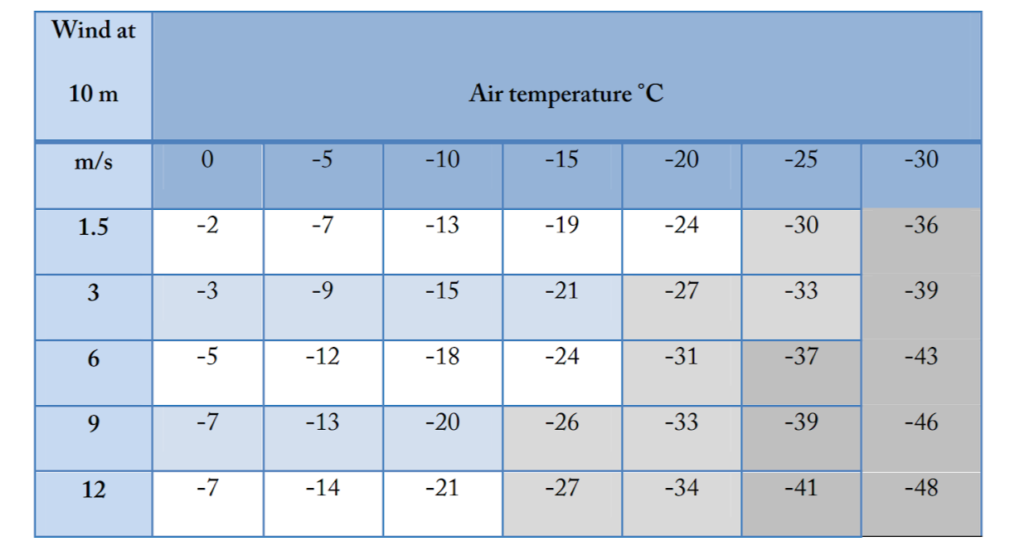
Table: Wind chill temperature with wind at 10 m
The body can perceive temperature very differently in frigid situations, especially when wind is present. The wind chill factor, which significantly lowers felt temperatures and increases the danger of frostbite, is determined by the combination of wind speed and air temperature. This is especially true for the temperatures in gray areas of the table.
Hence, effective winter textiles must not only provide thermal insulation but also be windproof to offer maximum protection.
Standards for cold weather apparel
The standards are categorized into the commercial sector and daily consumer use.
Commercial sector
In the commercial sector, the International Organization for Standardization (ISO) has developed a systematic approach to evaluate and prevent cold-related work problems. This includes:
- Evaluation Approach:Using checklists and observations, evaluate cold-related challenges, classify them according to severity: mild, moderate, or severe, and then take necessary action.
- Metabolic Rates: Assist in choosing suitable insulation for clothes by categorizing energy consumption according to job intensity.
- Instruments/Cold Surfaces: Standardising surface temperature recording methods and reactions to various materials at variable temperatures.
- Clothing Standards: These standards address thermal insulation, water vapor resistance, evaporation efficiency, and cooling efficiency of workwear.
- Cold Stress: Differentiating between local and whole-body cooling needs, using tools such as IREQ to determine the amount of insulation needed in clothes as well as what kinds of accessories, such as gloves, are needed to avoid numbness.
Daily Consumer
In the realm of daily consumer outdoor activities, while there’s a lack of comprehensive studies, certain standards have emerged as producers develop new types of winter clothing. Key requirements for producing a good winter jacket include:
- Layers: While multiple layers provide insulation, too many layers can reduce flexibility and increase energy needed for movement. According to research, a system’s metabolic rate rises by roughly 4% for every extra layer worn; wearing four layers raises metabolism by 5-8%. Another issue is weight; according to industry standards, 1 inch (~2.54 cm) of material is equivalent to 4 clo.
- Breathability: Adequate ventilation reduces heat loss from the body and prevents pain from sweat clots. Jackets with membranes or micropores let moisture through, improving breathability.
- Waterproof and windproof jackets: These jackets keep the wearer dry by preventing moisture from infiltrating internal layers.
Market Analysis
We have attempted to address the following unfulfilled market needs in this project.
- Cold Weather Textiles:
- Despite their widespread use and affordability, synthetic fleece materials frequently lack the necessary thermal insulation qualities.
- Although down insulation is available, it is more expensive and heavy, hence thinner and less expensive jackets are needed.
- Cheap jackets are in demand to cater needs of lower-class people
- Cold Weather Sports:
- High-performance thermal insulation that doesn’t impede mobility is necessary for activities like skiing, climbing mountains, and camping.
- Current jackets may restrict movement and increase fatigue, reducing performance and resulting deaths in unfavorable conditions.
- There is a need for materials that are lighter, affordable, and more flexible in the market.
- Special Care for Older People:
- Older people are more susceptible to heat loss and have lower metabolic rates, which increases their risk of getting cold.
- Affordability and discomfort difficulties with bulky clothing contribute to a rise in casualties among older people.
- Work Related:
- Various jobs, such as sailors, researchers, and oil platform workers, require thermal insulating clothing under adverse weather conditions.
- Productivity is directly impacted by thermal comfort, especially in military environments where good thermal insulation is critical to the safety and performance of soldiers.
- Lighter, weatherproof uniforms are necessary to improve movement and lower heat loss.
Laws and Theories Involved in Thesis
Thermal Equillibrium
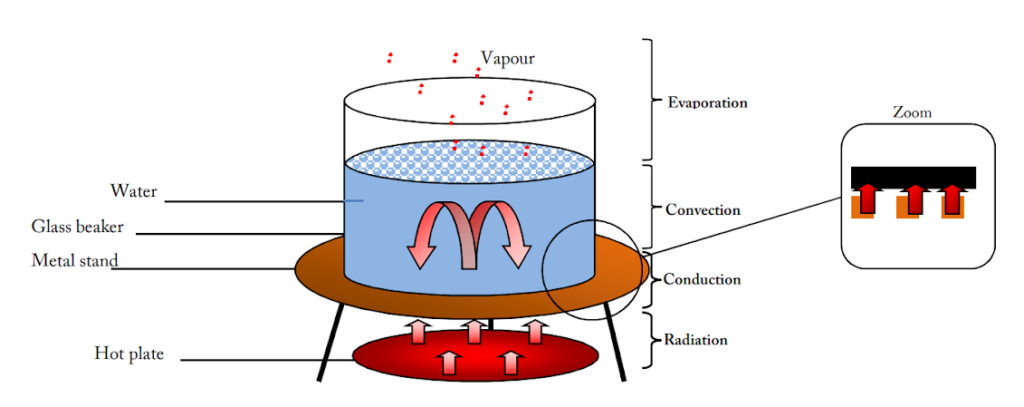
Energy moves between two systems when they are brought together until they reach thermal equilibrium or equal temperatures. Through the exchange of internal energy, this process is governed by the first law of thermodynamics.
Heat transfer takes place via convection, conduction, evaporation, and radiation from colder to warmer regions.
Thermal Conductivity and Resistance Value
Thermal Conductivity works on following principles:
- The rate at which heat is transferred through a substance is measured by thermal conductivity, or K value.It is expressed in Watts per temperature gradient of one Celsius per meter thickness. The formula to calculate thermal conductivity is given as,
Q = (K × A × ΔT) / L, where
Q=amount of heat transferred.
A=surface area.
ΔT=temperature gradient.
L=distance in the direction of conduction.
Every material, including air, has a thermal conductivity value.
- Thermal resistance, represented by the Rb value, is the thickness of the material divided by its conductivity value. This value changes based on the temperature gradient. The formula for thermal resistance is
Rb = d / U, where
d=thickness of the material.
U=thermal conductivity of the material.
The units for thermal resistance is m-2°C-1/W. The material’s thermal resistance is mostly determined by its thickness.
How Thermal Conduction is Analyzed Through Fabric?
Every mode of heat loss requires a different analysis of heat transfer through fabric.
Lower thermal conductivity fibers limit heat loss through the material as a whole.
Radiation-related heat loss is complex and needs more research.For this thesis, heat loss through convection and evaporation is neglected due to their minimal contribution to overall heat loss from the body.
Radiation Heat Loss Through Material
Radiation heat loss through a material is another aspect of the heat loss principle, alongside thermal conduction. Radiation heat loss is more complex than conduction heat loss. This formula is used to determine radiation heat loss through a thick fabric:
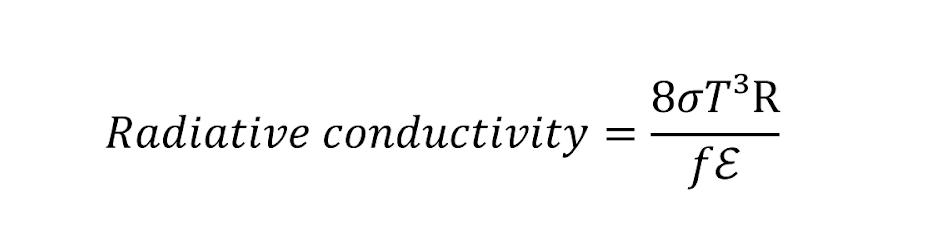
Where,
ℰ = thermal emissivity
R = radius of fibers
T = temperature between the heat source and surface.
f = fractional fiber volume
The ability of the material to emit radiation is explained by its thermal emissivity (ε).
Due to the temperature difference between the surface of the fabric and the heat source, the formula takes into account the radiation emitted from the material’s surface.
How does human skin impact body temperature?
In addition to introducing formulas for heat loss and thermal insulation, the thesis goes on to address the importance of human skin in controlling body temperature.
The thesis explains how the skin regulates heat and controls evaporation, which helps to keep the body’s core temperature stable.
It also briefly discusses Ohm’s law, which relates voltage, current, and resistance in electrical systems, and explains how heat generated by electrical energy in materials can be understood using this law.
Implementing Laws to Develop Modern Insulating Material
A possible remedy is presented in the form of spacer fabrics, which have special qualities related to thermal insulation.
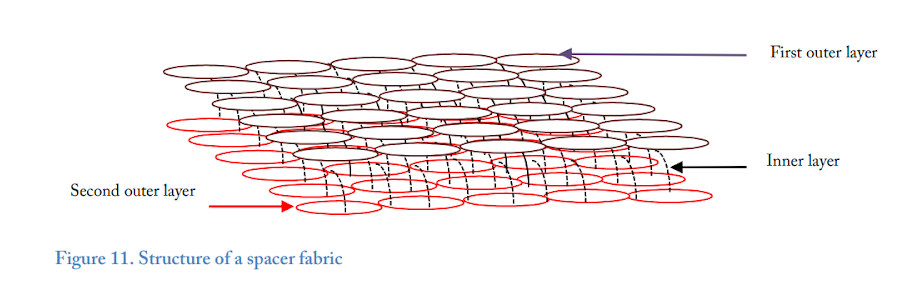
Structure of spacer fabric
Because traditional coating techniques were inappropriate, adding a reflective layer to spacer fabrics presented difficulties. To achieve the desired reflecting layer, special reflective yarns are investigated, especially metallic yarns composed of aluminum.
Three different kinds of metallic yarns are taken into consideration: round yarns, reinforced yarns, and thin film yarns. Each form of yarn has pros and cons.
With the use of metallic yarns like aluminum, there’s a significant focus on improving the material’s reflecting qualities to reduce heat loss.
Consideration of Material Properties and its Production:
Tensile strength, elongation, and thermal conductivity are just a few of the attributes that influence the choice of yarns.
The creation of materials relies heavily on knitting technology, which requires intricate programming and setting adjustments to provide the right structure and qualities.
Material Testing
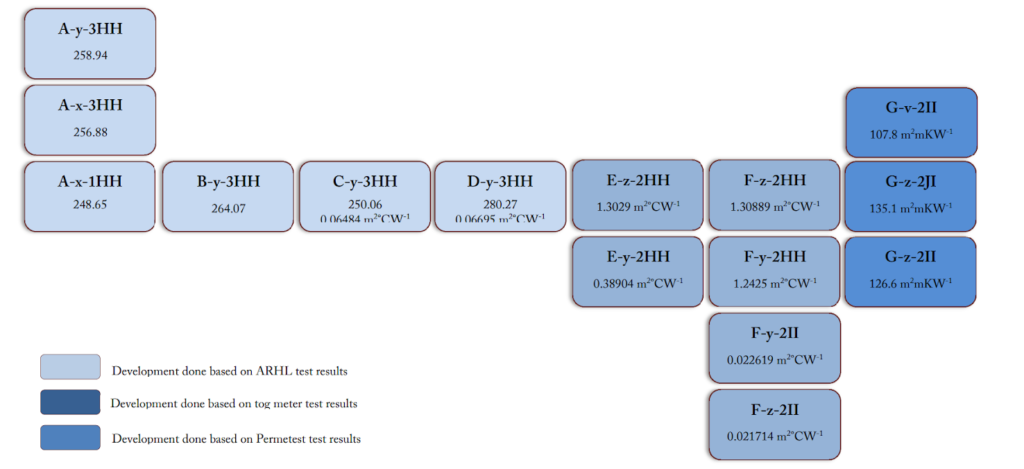
Results and Observations for Each Material:
- A range of items are created and evaluated, and each is accompanied by observations and findings.
- Documentation is kept on material properties such density of reflective yarn, shrinkage, and thickness.
- Observations include yarn behavior, breakages in the yarn, and structural stability.
- The thermal resistance values (R-value) of each material are shown in the test results, indicating improvements over iterations.
- Every substance has an image for visual reference.
Table of Material Test Results:
| Material | Thickness | Shrinkage | Reflective Yarn/cm | R Value (m²°CW⁻¹) |
| A-x-1HH | 4.65 mm | 52% | 15 cm X | 248.64 |
| A-x-3HH | 7 mm | 29% | 22.5 cm X | 258.94 |
| C-y-3HH | 7 mm | 29% | 22.5 cm X | 250.068 |
| D-y-3HH | 6.3 mm | 29% | 22.5 cm X | 280.27 |
| E-z-2HH | 7 mm | 24% | 24 cm X | 1.3029 |
| F-z-2HH | 7 mm | 24.5% | 24 cm X | 1.30889 |
| G-z-2II | 4 mm | 15% | 27 cm X | 126.6 |
| G-z-2JI | 3.7 mm | 18% | 26 cm X | N/A |
These results provide insights into the thermal insulation properties and structural characteristics of each material developed. Based on the results it can be observed that the Thermal reflective spacer material has a higher thermal insulation value compared to any other material, This is more than 30% increment over traditional spacer material.
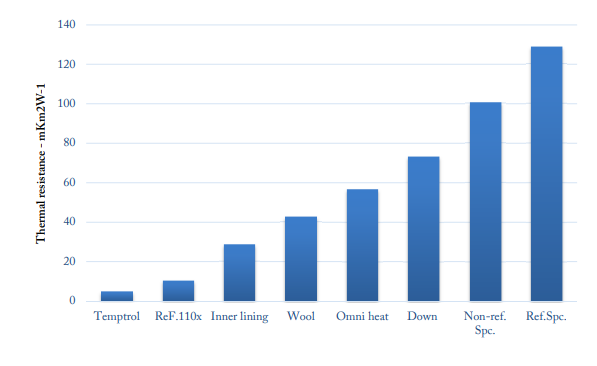
Testing Methods
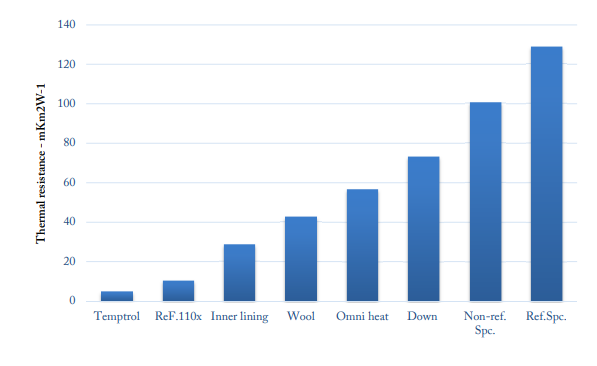
The benchmarking of thermal insulation materials with the Permetest instrument has been done during the process. The temperature resistance of a variety of materials, including duck down, Omni heat, felted wool, etc., was examined. According to the results, reflective spacer material works better than the others, obtaining 128.6mKm2W01, which is 120% better than Omni heat and 75% better than duck down.
Results and Advantages of New Insulation Material
In conclusion, a new thermal insulation material is developed and its benefits over conventional materials such as down are highlighted:
- The material has a strong heat resistance and is recyclable. It is primarily composed of PES with aluminum metalized yarn.
- Additionally, it is anticipated that clothing would become thinner and more flexible, making it appropriate for soldiers and the elderly.
- It might be affordable for a wider market and need fewer, easier production procedures.
Limitations of the thesis
The thesis acknowledges several limitations:
- Cost and material utilization estimates were not disclosed since they may be improved.
- It was difficult to get accurate reflectivity values from M-IR spectroscopic photos.
- Materials stability and insulation may be improved by using stronger knitting machines.
- Production-related deformation affected the final test findings, resulting in values that were not satisfactory.
- The material was breathable, thus no vapor permeability test was required.
- Wet-condition thermal resistance testing was not feasible with the Permetest apparatus.
Review the full thesis here. (source)